Introduction
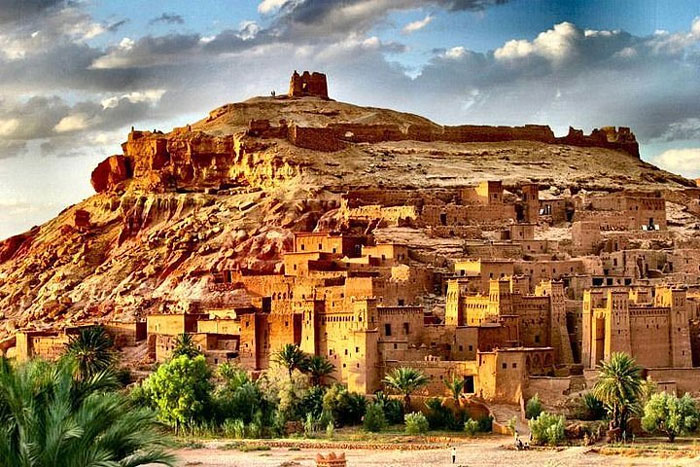
Throughout Morocco, from the Atlas Mountains to the edge of the Sahara Desert, stand impressive earthen fortresses called ksour (plural of ksar) and kasbahs, true testament to the country’s architectural ingenuity and cultural richness. Built of rammed earth, these structures served to protect inhabitants from attacks and extreme weather conditions, while reflecting the social and tribal organisation of the time. Ksours, often surrounded by ramparts, were fortified villages, while kasbahs were the residences of local chiefs or notables. Their ochre colour, which blends perfectly with the surrounding landscape, still fascinates visitors, historians and history enthusiasts today. Iconic sites such as Aït Ben Haddou, Taourirt and Amridil offer a unique insight into traditional Morocco and life in the heart of the oases.
What are a ksar and a kasbah?
The term ksar refers to a fortified village traditionally built of rammed earth, whose dense and compact layout served primarily to protect its inhabitants from external attacks. Each ksar is surrounded by a massive rampart pierced by narrow gates, sometimes equipped with defence mechanisms. Inside, the houses are intertwined, forming a labyrinth of narrow alleys that facilitate defence but also social cohesion. The ksar is not only a residential space: it also houses collective granaries, mosques, gathering places and sometimes Koranic schools.
The kasbah, on the other hand, is generally a fortified residence belonging to an influential family, a tribal chief or a local dignitary. Less communal than the ksar, it is characterised by more monumental architecture, with watchtowers, defensive battlements, inner courtyards and facades decorated with traditional relief patterns. The kasbah served to protect the family and its property, but also to exercise local political authority. Some kasbahs also served as checkpoints for trade caravans crossing the Sahara.
Architecture and materials: earth at the heart of the building
The distinctive feature of ksours and kasbahs lies in the use of rammed earth, a natural mixture of clay, water and plant fibres, compressed in layers to form sturdy, insulating walls. This traditional technique, adapted to climatic constraints, provides excellent thermal regulation. In summer, the thick walls keep the interior cool, while in winter they retain heat. The warm colours, ranging from red ochre to orange-yellow, blend perfectly with the surrounding desert landscape, giving these fortresses an organic appearance that seems to rise up from the ground.
However, rammed earth is vulnerable to bad weather, particularly heavy rain, which can damage the walls. Regular maintenance involving plastering and repairs is therefore essential to preserve these structures. This activity also perpetuates valuable craftsmanship, with local artisans who are experts in working with earth.
Geographical distribution of ksours and kasbahs in Morocco
The Draa Valley
Located in south-eastern Morocco, the Draa Valley is a spectacular oasis stretching nearly 200 km between Ouarzazate and M’Hamid El Ghizlane, at the gateway to the Sahara Desert. Flanked by the Draa River, it is lined with thousands of palm trees, cultivated gardens, and above all, ancient ksours built of adobe.
Fortified villages such as Tamnougalt, Tamegroute, Zagora and Agdz bear witness to a prosperous past when trans-Saharan caravans stopped there to trade. These ksours often feature communal granaries, traditional mosques and mud-brick houses decorated with geometric patterns. Some, now in ruins, nevertheless retain their symbolic power and major heritage value.
The Dadès Valley and the Valley of Roses
These two neighbouring valleys are nestled at the foot of the High Atlas Mountains, in the Tinghir region. The Dadès Valley is known for its spectacular rock formations and majestic kasbahs, perched above the gorges or nestled among palm groves.
The Valley of Roses, which stretches around the town of El Kelaa M’Gouna, is famous for its rose cultivation and rose water distilleries, but also for its adobe kasbahs, which are often decorated and restored. Among the best known is the Kasbah of Aït Youl, a magnificent example of Berber architecture.
These kasbahs bear witness to the lifestyle of the noble families and local clans who dominated the valleys, controlling water, agricultural land and trade.
The Ouarzazate region
Nicknamed “the gateway to the desert”, Ouarzazate is a strategic and historic city, a true crossroads between the Atlas Mountains and the Sahara. The region is full of iconic kasbahs, some of which are world-famous.
The Taourirt Kasbah, in the heart of the city, was the residence of the Glaoui, a powerful pasha of the 20th century. It is a monumental, labyrinthine construction, richly decorated with stucco, zellige and carved wood.
Not far away, about thirty kilometres away, is the legendary ksar of Aït Ben Haddou, a UNESCO World Heritage Site. This fortified village is one of the best preserved in Morocco and is often used as a backdrop for historical films. It embodies traditional Saharan architecture.
The Middle and High Atlas Mountains
The mountain ranges of the Middle and High Atlas are home to Berber villages built on mountainsides, often accessible only on foot or by mule. In these regions, the kasbahs are more modest than those in the southern Sahara, but they are deeply rooted in Amazigh (Berber) culture.
There are defensive kasbahs built of stone and earth, often surrounded by communal granaries called igoudar or agadir, evidence of a communal way of life. These kasbahs, some of which are still inhabited, served as both a refuge and a centre of life for families.
Notable regions include Imilchil, Tounfite, and the Anergui Valley, where dry stone architecture blends into the rugged environment, reflecting a perfect adaptation to the mountain climate.
The most famous ksours and kasbahs in southern Morocco
Ksar of Aït Ben Haddou: An icon of world heritage
Located about thirty kilometres from Ouarzazate, the ksar of Aït Ben Haddou is undoubtedly the most famous in the country. This fortified village, built entirely of earth (adobe), is a perfect example of Morocco’s pre-Saharan architecture.
Listed as a UNESCO World Heritage Site since 1987, the ksar consists of several traditional houses, granaries, defence towers and narrow, sloping streets. Although most of the inhabitants have left the site for more modern housing on the opposite bank of the wadi, a few families still live there, perpetuating local traditions.
Its spectacular ochre silhouette has captivated many film directors. The ksar has served as the backdrop for several world-famous films and series, such as Gladiator, Lawrence of Arabia, Kingdom of Heaven and Game of Thrones, further enhancing its international reputation.
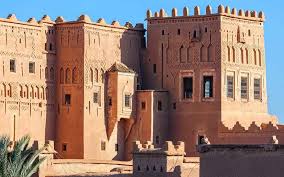
Kasbah of Taourirt: The beating heart of Ouarzazate
In the heart of the city of Ouarzazate stands the majestic Taourirt Kasbah, an impressive building with a rich history. Built in the 19th century, it was the residence of the powerful caid El Glaoui, nicknamed “the Lord of the Atlas”, who played a central political role during the colonial era.
Its interior architecture is a veritable labyrinth, with its multiple rooms, salons, spiral staircases and interior courtyards. The walls are finely decorated with sculpted stucco, painted cedar wood ceilings and zellige tiles, illustrating the artistic refinement of the period.
Now partially restored, the kasbah is open to visitors, who can admire the layout of a traditional Saharan palace while enjoying breathtaking views of the medina and the surrounding mountains.
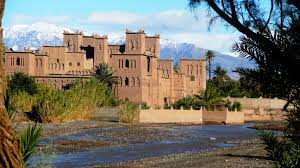
Kasbah of Amridil: Hidden treasure of the Skoura palm grove
Nestled in the heart of the lush palm grove of Skoura, the Kasbah of Amridil is one of the best preserved in southern Morocco. Founded in the 17th century, it is an exceptional example of defensive adobe architecture. This iconic monument also appears on the old 50 dirham Moroccan banknotes, proof of its cultural importance.
Unlike other kasbahs, Amridil is still inhabited and maintained by the family that founded it. It has been partially converted into a museum, allowing visitors to discover daily life in a kasbah: wells, oil mills, traditional utensils, reception rooms, and space for animals are on display.
Its geographical location, nestled between palm trees and wadis, adds to its charm and makes it an essential stop for travellers seeking authenticity and architectural beauty.
Cultural significance and preservation challenges
Ksour and kasbahs are much more than ancient architecture; they represent a way of life based on community, solidarity and adaptation to a hostile environment. They bear witness to the ingenuity of the Amazigh and Arab peoples, who were able to transform the land into sustainable and harmonious shelters. These fortresses were also economic and cultural hubs, crossing points for caravans, and places of exchange between peoples.
Today, these structures face many challenges. Rural depopulation, modernisation, climate change and lack of maintenance threaten their survival. Aware of this fragility, Morocco has set up several restoration and protection programmes, often in collaboration with international organisations. These efforts aim to safeguard this unique heritage, promote cultural tourism and preserve a living testimony to the traditions of southern Morocco.
Conclusion
The ksours and kasbahs of southern Morocco are true gems of architectural and cultural heritage. They offer a fascinating journey through time and traditions, revealing the history of a resilient and creative people. Exploring these earthen fortresses is to understand how humans have, throughout the ages, adapted to a difficult environment while creating beautiful, functional and deeply human living spaces. These monuments are invitations to discover an authentic Morocco, far from the beaten track, where every stone tells a story.